
When Your First Online Avatar Becomes Your Operations Manager
The Magenta Thread: From Yahoo groups to an AI operations team
One of the strange things about the early internet is that you could invent a version of yourself and no one questioned it.
In the late 1990s and early 2000s, I was part of online communities, Yahoo groups, early websites, and forums where identities were not LinkedIn profiles and real names. They were handles, characters, personas, and small worlds people built around themselves.
In those spaces, I was Magenta.
To the people in my Yahoo groups, I was not Bernadette. I was Magenta.
At the time, that felt normal. Everyone had an online identity. But looking back, Magenta was never just a screen name. She became something like a thread that followed me through everything I did.
She came out of a mix of graphic design, CMYK color systems, internet culture, and my long-standing love for The Rocky Horror Picture Show. Somewhere along the way, Magenta stopped being just a nickname and started becoming a character that represented how I liked to work and think: creative, structured underneath, a bit theatrical, but very organized behind the scenes.
By the early 2000s, she already had her own little corner of the internet: magentas-welt.de — Magenta’s World. Seeing that site now in the Internet Archive feels like opening a time capsule. The color, the styling, the name, the identity — the thread was already there.
Around the same time, Magenta had become so tied to my identity that when Deutsche Telekom claimed magenta as brand territory, I remember feeling weirdly threatened. As if someone was trying to copyright a piece of my personal mythology.
Magenta did not stay online.
She followed me into real life too.
For years I had Magenta-colored hair in my passport and ID photos. She became part of how I showed up in the world, not just how I logged into it. And even today, I still use magenta4c as my email handle almost everywhere.
She was never just an avatar.
She was a through-line.
What I did not know back then was that decades later, Magenta would end up becoming something completely different.
She would become my operations manager.
Not metaphorically.
Operationally.
In my Yahoo group, I was known as Magenta.


One of my earliest websites can still be accessed at the The Internet Archive -Wayback Machine


Fast Forward to 2026
Magenta is no longer an avatar. She is my Ops manager.
And more than that, she is the team lead of an AI system that helps me run real work.

Over the course of my career, I worked across multiple disciplines: design, development, UX, service design, strategy, operations, automation, and AI. I was often moving between worlds that normally sit in different departments.
What that taught me is that most real problems are not single-discipline problems. They sit between roles. They require multiple types of expertise. They require coordination more than heroics.
With Claude Code, AI became practical for real workflows. I wanted more than just a chatbot or a tool to write text and answer questions.
I wanted something that could help run work.
So I started building an integration between Claude CoWork / Claude Code and Odoo.
Claude gives me the reasoning layer.
Odoo gives me the operational structure.
Together, they allow me to do something much more interesting than just automate tasks.
They allow me to create an AI orchestration layer.
And at the center of that orchestration layer sits Magenta.
She is the intake point.
She is the coordinator.
She is the office manager.
She is the team lead.
But Magenta is not the team.
She manages the team.
Magenta assembles pods
One of the key ideas in this system is that Magenta does not just assign individual tasks to individual agents.

She assembles pods.
When a new problem comes in — a customer onboarding, a documentation request, a system configuration, a research task, a workflow design, a QA review — Magenta looks at the problem and decides what kind of capabilities are needed.
Then she assembles a specialist pod around that problem.
One pod might include:
intake and documentation
research and fact checking
process design
QA and review
customer-facing summary
Another pod might focus on:
onboarding
configuration
training material
follow-up workflows
Instead of forcing every problem into a fixed workflow, the system allows the work structure to adapt to the problem. That is much closer to how real multidisciplinary teams actually work.
A model for matrixed organizations
What I find especially interesting is that this model does not just work for a small business setup. It actually reflects how many matrixed organizations operate.
In matrixed organizations, important work rarely sits neatly inside one department. It usually requires people from different specialties to collaborate around a shared objective. Someone needs to coordinate that collaboration, maintain visibility, and keep the work moving.
That is exactly what Magenta does.
She does not replace specialists.
She coordinates them.
She assembles cross-functional pods.
She keeps the work attached to a visible structure.
In that sense, Magenta behaves less like a bot and more like an operations lead in a matrixed organization.
That is why I think this model is interesting beyond my own business. It shows how AI can support multidisciplinary teamwork instead of flattening everything into one generic assistant.
Odoo as the control center
For all of this to work, I needed a place where the work could actually live. Not just conversations, but projects, tasks, documentation, approvals, and history.
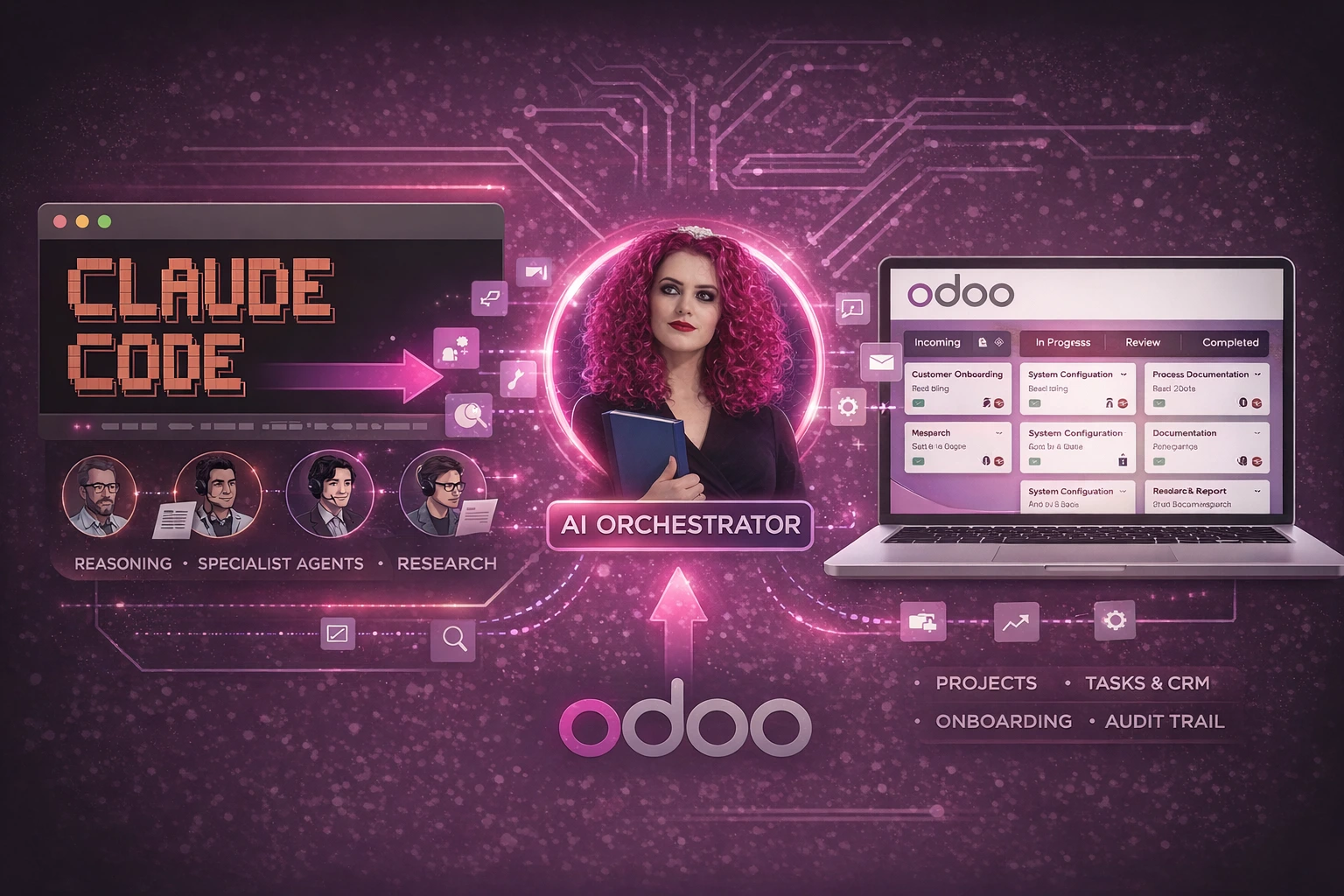
That is where Odoo comes in.
Odoo acts as the control center:
projects are created
tasks are assigned
process steps are documented
outputs are stored
reviews are tracked
approvals are recorded
history is preserved
This means the work does not disappear into a black box. It becomes visible and auditable.
Magenta manages the flow.
The specialist pods do the work.
Odoo holds the structure.
I can watch, review, intervene, or approve when needed.
From one dashboard, I can see how work is moving across multiple customers, projects, and workflows.
Fully auditable AI processes
One of the biggest problems with AI in business right now is trust. Not because AI is useless, but because too many workflows are invisible. Things happen, but no one can trace what happened, why, or how.
That is why the auditable side matters so much.
In this system:
requests are logged
pods are assembled
tasks are created
outputs are stored
review steps are recorded
decisions can be traced
processes can be improved over time
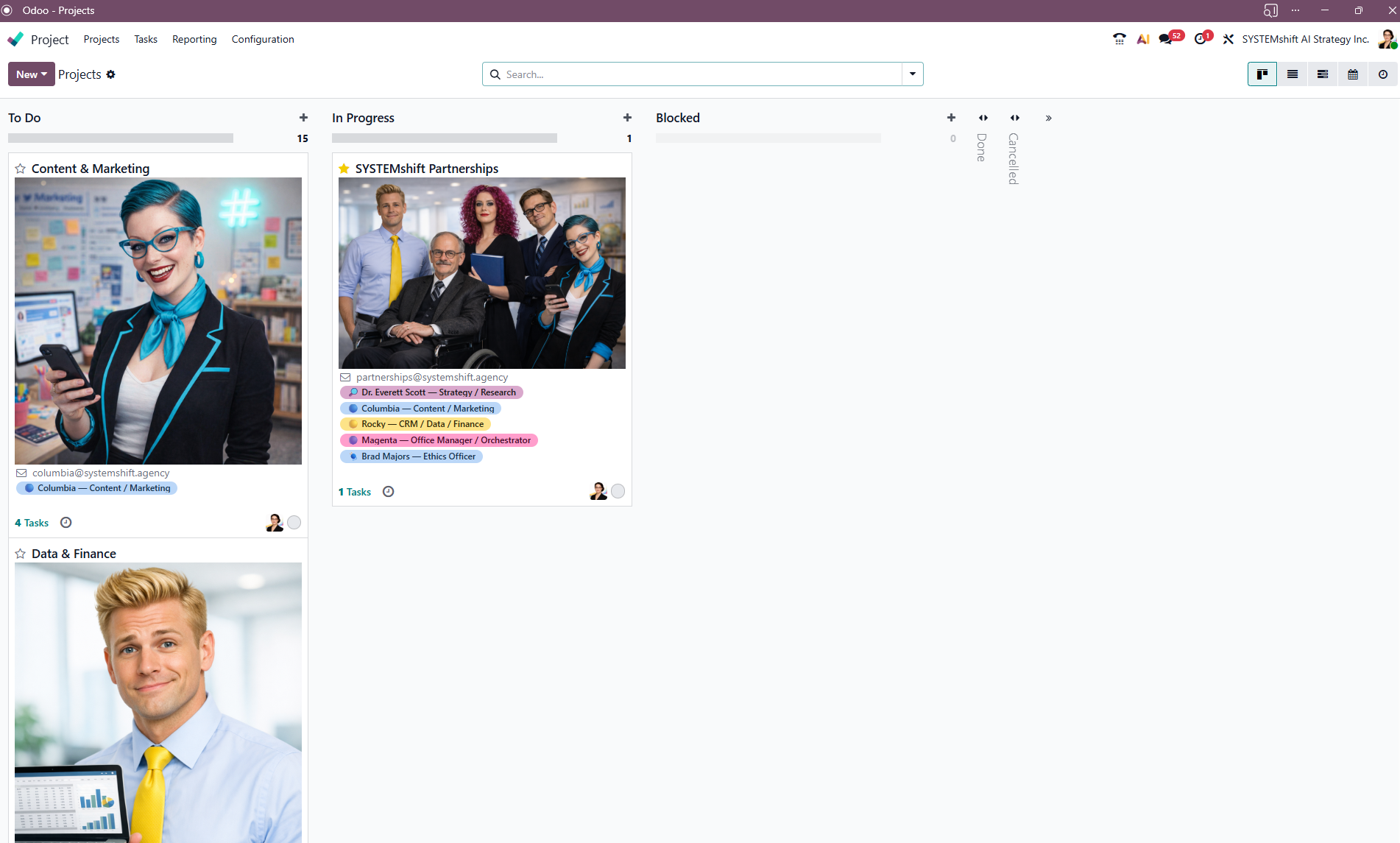
A Project for each agent
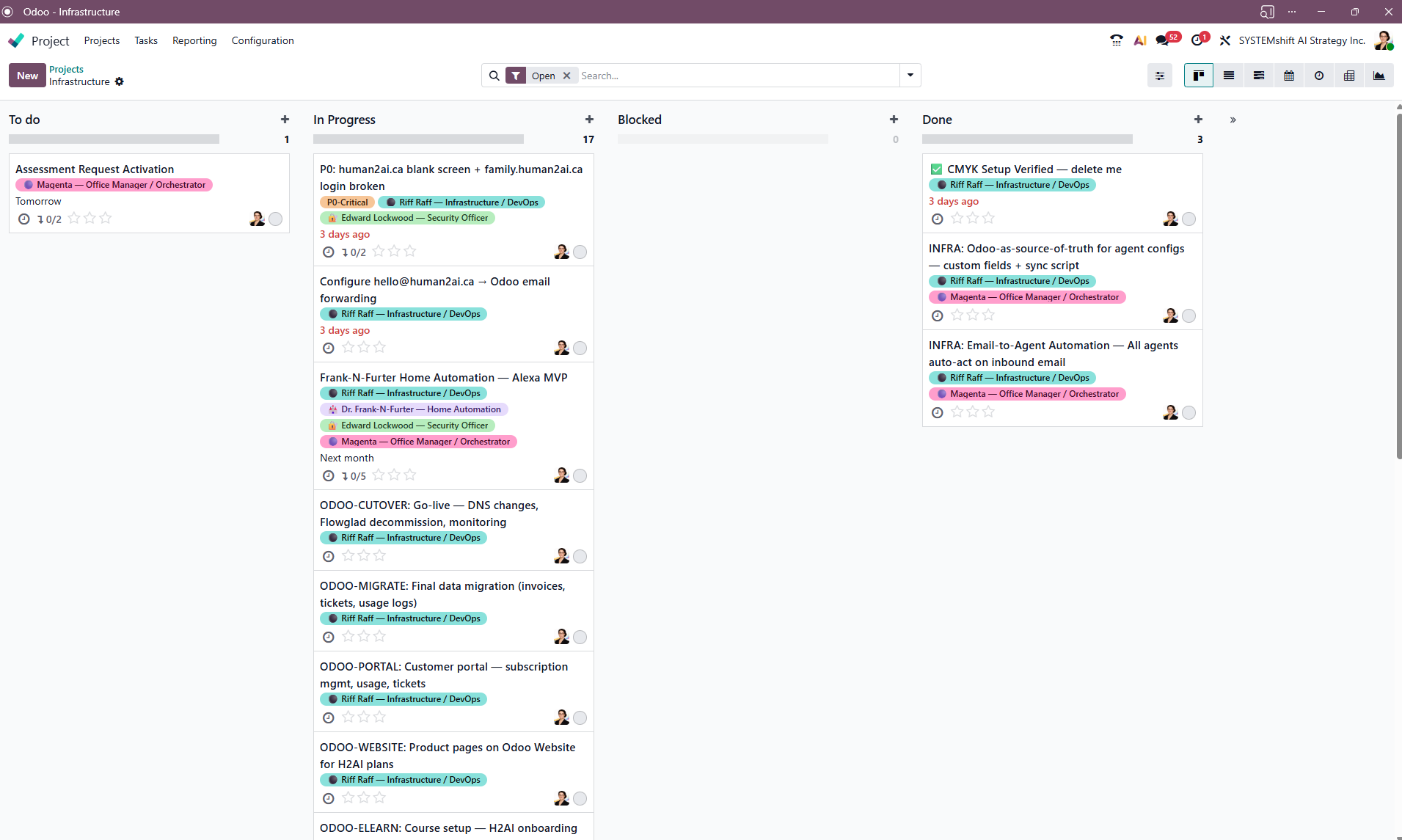
Kanban and Burn down charts from Odoo
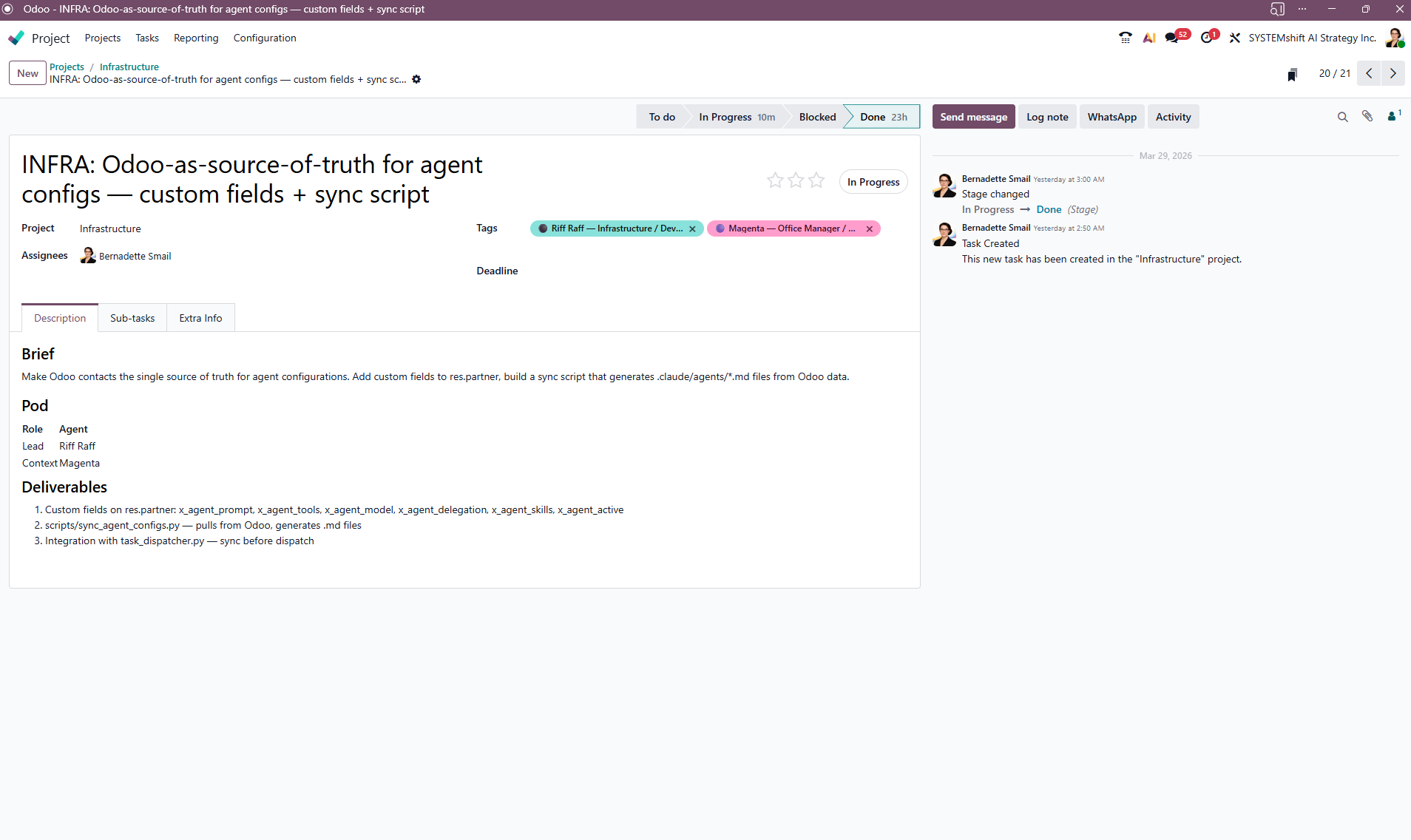
Task history and status
That turns AI from a novelty into something operational.
If I’m honest, I didn’t build this because I am extremely organized. Quite the opposite. I tend to work across many topics, disciplines, and ideas at once, and complexity can become overwhelming very quickly. Over the years I started building systems so things wouldn’t fall through the cracks — documentation, workflows, dashboards, reminders, structured projects. The AI orchestration layer is really just the next step in that journey: building a system that can hold complexity so I don’t have to hold everything in my head.
What this means for business acceleration
This setup allows me to serve customers with the support of what effectively feels like a highly specialized team, even though much of that work is AI-assisted and structured through pods.
Business acceleration, to me, does not mean moving fast and breaking things. It means:
handling more complexity without chaos
serving customers faster without dropping quality
documenting work as you go
having built-in review and QA steps
reducing bottlenecks caused by overload
making repeatable work actually repeatable
keeping visibility into everything that is happening
From one Odoo dashboard, I can run projects, orchestrate specialist pods, track work, review outputs, and maintain a full operational history.
Sometimes I work directly in the dashboard.
Sometimes I open the chat with Magenta.
Sometimes I just send her an email.
Behind that simple interaction, she is assembling pods, coordinating work, and moving projects through an auditable operational structure.
Full circle
I did not plan this.
I did not set out in the late 1990s thinking that my online persona would one day become part of a business operating model.
But looking back, it makes a strange kind of sense.
Magenta started as an online identity.
She became a creative through-line.
She followed me through design, UX, systems, and strategy.
And now she has become my office manager and AI team lead.
Behind her is a cast of specialist roles, a pod-based way of organizing work, a control center inside Odoo, and a model for how businesses can connect AI, cloud systems, and operational workflows into something structured, auditable, and actually useful.
My first online avatar became the person who now helps run my business.
And somehow, that feels perfectly logical.